
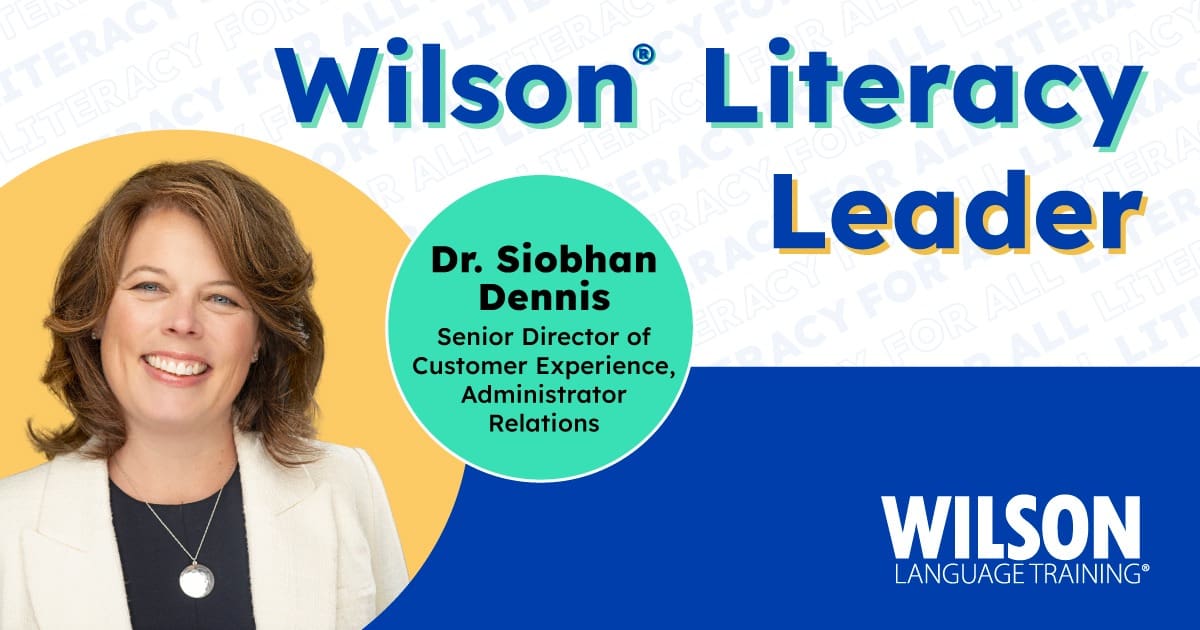
At Wilson Language Training®, our dedicated team members are passionate about ensuring literacy for all. One such leader is Dr. Siobhan Dennis, Senior Director of Customer Experience, Administrator Relations. With a background as a teacher, reading specialist, and elementary school principal, Siobhan now leads our team of literacy advisors and works closely with school and district leaders across the country to support effective literacy instruction. In this spotlight, she shares her journey, insights on Structured Literacy, and the impact of Wilson® programs on educators and students alike.
I started my career as a fifth-grade teacher and reading specialist before moving into higher education, where I taught at the college level and supervised student teachers. While earning my school administrator license, I transitioned into administration and spent several years as a special education team chair and an elementary school principal in Massachusetts. I continued my formal education, while a principal, earning a Ph.D. in Educational Leadership. My dissertation focused on the influence of instructional rounds on the role of the principal.
As a school principal, I had the opportunity to partner with Wilson to support literacy instruction in a unique pilot looking at the impact of strong foundational skills instruction tied to a knowledge-building curriculum. During the pilot, Barbara Wilson and a team from Wilson spent time in my building witnessing the intentional approach I was leading around curriculum implementation to support the teachers and drive instructional progress for all students. We focused on creating the right conditions for teachers—clear expectations, strong professional learning, protected instructional time, and consistent monitoring of implementation.
At that time, Wilson was developing a role dedicated to helping building-based leaders understand and operationalize the conditions required for successful implementation, grounded in implementation science. That alignment between my experience and Wilson’s vision drew me to the organization where I have been for the last 9 years.
I work with school and district leaders across the country to strengthen their implementation efforts at a system level Literacy for all requires more than just strong instructional materials – it requires coherent solution architecture that aligns leadership, professional learning, instructional expectations, and shared accountability. I lead the literacy advisor team, and together we partner with district and building-based leaders to build the conditions necessary for successful implementation and ensure that students receive the instruction they need to become proficient readers. When districts have strong systems in place to support their teachers, students consistently receive the structured, systematic instruction they need to become proficient readers. That systems-level coherence is what turns the vision of literacy for all into reality.
I love collaborating with Wilson literacy advisors to develop solutions that help districts support their educators and help all students have access to high-quality instructional materials. Visiting schools and seeing teachers equipped with the knowledge and tools to teach reading effectively is incredibly fulfilling. Knowing the systems and structures behind them are strong—brings the work full circle. Another meaningful area of my work has been collaborating with the LA team to enhance and refine professional learning opportunities for administrators and teachers. We’ve worked to ensure that professional learning is not just informative, but transformational—grounded in adult learning theory, aligned to implementation science, and directly connected to classroom practice.
Every opportunity I have to support administrators in building their knowledge as literacy leaders stands out. I’ve had the opportunity to travel across all areas of our country to work with school leaders to strengthen their implementation efforts. When school leaders understand how to support their teachers and students, they create environments in which literacy instruction thrives.
I’m grateful to be able to recall countless success stories—some quiet and personal, others transformational at a systems level. But the most powerful moments are when a child or an adult learns to read and you can see the shift happen in real time. When literacy clicks, possibility expands. Confidence replaces frustration and agency replaces dependence. In that moment, the future feels different—brighter, broader, more self-directed. Every time that happens, we’ve contributed to something far greater than a skill—we’ve helped change the trajectory of a life.
Wilson is a pioneer in Structured Literacy. Every program is rooted in the science of reading and designed to support students at all three tiers of instruction. But beyond the curricula, Wilson provides a comprehensive system of support with talented, experienced literacy experts guiding implementation at district, school, and classroom levels. Our literacy experts don’t just provide materials—we partner with districts to design and sustain the conditions required for success. That systems approach ensures implementation is not left to chance.
Providing ongoing professional learning and ensuring that teachers implement high-quality curricula with integrity are essential. Teachers need support, training, and resources to effectively meet the needs of all learners. School leaders are most successful when they can use the implementation science framework to support this work.
There are so many to choose from, but I’ll pick the work I lead with the literacy advisor team. Having a literacy thought partner to help design and refine implementation plans at the district level makes a significant difference in successful adoption. This also forges some really great friendships and thought partnerships. Access to literacy experts who have masterfully done this work in other districts and can share their lessons learned can help to elevate literacy impact with our partner districts.
Teaching someone to read changes the trajectory of a life. Literacy is a human right, and when students receive structured, evidence-based instruction, they don’t just learn to decode words—they unlock access to knowledge, opportunity, and self-determination.
I’ve seen students move from frustration and self-doubt to confidence and pride. I’ve watched doors open academically, socially, and emotionally once reading becomes a strength instead of a barrier. When a student becomes a reader, their world expands—and so does their belief in what’s possible for their future.
FUN HUB®, FUN HUB Practice, and Fundations® Readers are game changers. Students need additional practice opportunities, and these resources provide dynamic, targeted ways to reinforce their learning. I also love Ready to Rise® our summer program for rising first and second graders.
The Fluency Kit—it’s a hidden gem! I always encourage teachers and administrators to unpack that box and put it to use for accessible and effective fluency practice.
Be diagnostic—analyze students’ responses to instruction and target your teaching to address their specific needs. The more precise your targeted instruction, the greater the impact and success you will have in supporting the reader.
Start by reading the overview section in the Fundations Teacher’s Manual for each chapter or Unit. Pick a few key instructional routines, watch the demonstration videos, master them, and then gradually build on them. Before long, you’ll be confident in all aspects of the program!
Integrity of the lesson design – paired with system coherence. Following the program as designed ensures that students receive structured, systematic instruction aligned with the science of reading. At the same time, leaders must build the structures that protect and sustain that instruction. Students cannot benefit from instruction they do not receive and teachers cannot deliver strong instruction without strong systems supporting them.
I would tell myself to follow the science of reading sooner. The research has been there for so long, but many educators haven’t been aware of it or trained in its practices. I would encourage myself to seek out and implement evidence-based instruction earlier in my career. I would also remind myself that strong instruction thrives in strong systems. Leadership matters. Coherence matters. And literacy truly is a human right.
Bridge to Terabithia. It’s a timeless story that captures the power of imagination, friendship, and resilience. Even as a child, I was drawn to books that opened new worlds and stirred deep emotion—and that story has stayed with me ever since. It was my favorite book to teach and share with my 5th grade students as well.
A teacher—without hesitation. Even though my role has evolved over the years, that calling has never changed. At my core, I am still a teacher. Whether I’m supporting district leaders, collaborating with literacy advisors, or designing systems for implementation, my purpose remains the same: to help others grow, learn, and succeed.
Jo March from Little Women. She’s fearless in her convictions, fiercely independent, endlessly curious, and unapologetically passionate about learning. Jo challenges expectations, pursues her purpose with courage, and never stops growing—and that spirit of boldness and lifelong learning deeply resonates with me.